
From Dhangadhi to AI Innovation
Dirgha Raj Upadhyay
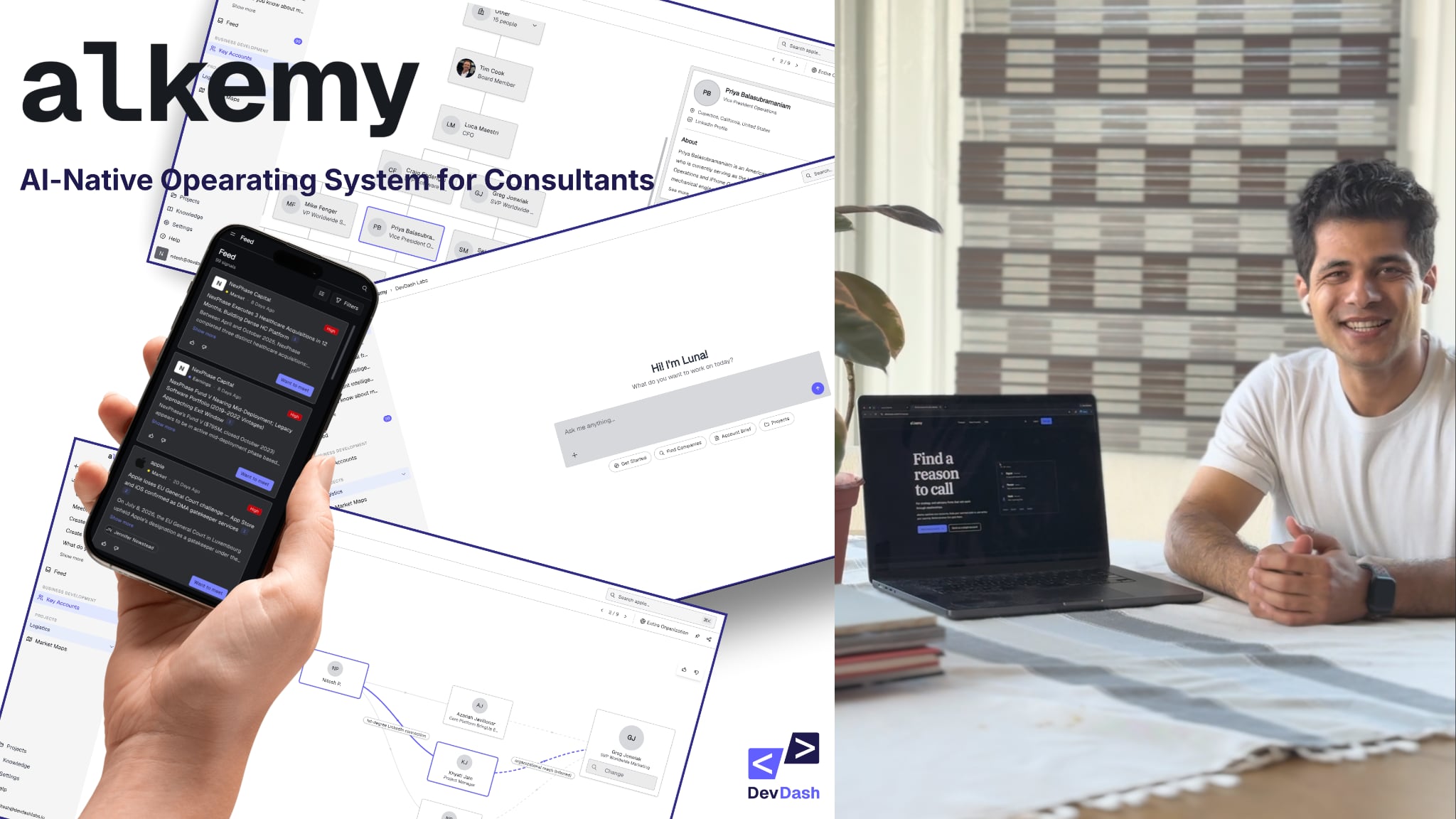
Nitesh Pant, who is 26, grew up in Dhangadhi and taught himself how the U.S. college-admissions process worked before attending Dartmouth College. Pant led the product and growth work behind alkemy at DevDash Labs. The Kathmandu engineering team is now developing alkemy, an AI product that enables U.S. consulting firms to work out who to call, why to call them and what to say by making use of the relationships they already have.
alkemy enables management consulting partners to turn their current networks into concrete opportunities. For example, one professional-services firm had 55 contacts at a large payments company but still struggled to identify whom to contact and why the timing mattered. Rather than sending another generic “just checking in” message, they often wait. By the time they act, the opportunity may have gone to somebody else.
Since consulting firms rely on relationships, those relationships tend to be kept in people’s heads. Pant’s research suggested that referrals are difficult to predict and that cold outreach is often ineffective for large deals. Although tools such as ChatGPT and Claude are powerful, standalone AI tools do not know a firm’s private relationship data unless the firm supplies or connects that context.
alkemy is intended for spotting important moments. For example, if a competitor such as Mastercard takes some action, alkemy can identify a relevant contact, explain why the timing matters, and draft an opening message using relationship data supplied by the firm. It also assists in identifying the best way to proceed through the relationships that the company already has. Tasks that once depended on a partner’s memory can now be surfaced more systematically, with outreach drafted in the partner’s voice.
At its heart, alkemy is based on a more general belief concerning the future of knowledge work. Pant argues that AI is changing the “analyst” layer, that is, the research, market analysis, and initial drafts that junior staff used to spend a great deal of time on, but it cannot take the place of the “partner” layer: the human individual who builds trust, makes decisions, shows judgment, and whose name is attached to the advice.
The more analysis becomes affordable, the more important relationships become. Pant argues that AI can produce analysis but cannot bear professional accountability for the final decision. Since machines are taking over a greater number of analytical tasks, human judgment and relationships will become all the more important.
alkemy is beginning with business development, but its ambitions are far greater: it wants to become the operating system for professional services companies, a private record of who knows whom, what has changed, what actions have been taken, and what has worked. Consulting is merely the starting point for a much wider field that also encompasses legal, accounting, and advisory services.
alkemy launched publicly on June 25, 2026. Between January 28 and July 13, Pant conducted 31 demonstrations across 29 external organizations. By July 13, six firms had signed non-binding letters of intent, and a 14-person consulting firm had signed and paid for a two-month pilot. Before the product specification was written, Pant conducted more than 125 research conversations with owners, partners, and advisers. As of August 4, users from more than 20 firms had signed up, and firms were paying to use alkemy through pilots.
DevDash Labs operates across two countries: the business problems come largely from U.S. professional-services firms, while much of the engineering takes place in Kathmandu. Its Nepali motto, “दामी काम गरौं,” means “let’s do work worth being proud of.” For Pant, one aspect of the mission is to demonstrate that Nepali builders are capable of producing products for the global market.







तपाईको प्रतिक्रिया